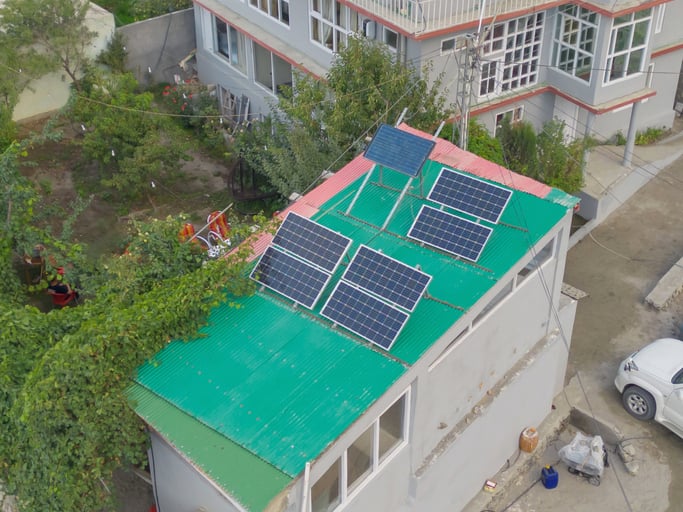
In just two years Pakistan’s power story flipped: national electricity use jumped 21% (about 33 TWh) and that growth was basically all from distributed solar — generation went from 15 TWh to 51 TWh while grid output actually fell a bit. Renewables First estimates around 38 GW of distributed solar by June 2025 (about 27 GW of that installed in two years), pushing solar’s share from ~10% to ~28% of generation (roughly 32% if you count avoided transmission losses). That rapid rollout happened because solar got cheap, net-metering and low import taxes made adoption easy, and people were desperate for reliable daytime power.
The change isn’t just rooftop prettiness — it’s reshaping whole sectors. Roughly 7 million households (18% of homes) now have solar, averaging ~2.4 kW each, which has unlocked daytime appliance use and a boom in cooling; industry switched to behind‑the‑meter systems as captive gas and coal fell; commercial users matched daytime loads naturally; and agriculture exploded with solar tubewells (solar rose to 61% of tubewells, diesel dropped from 79% to 28%, tubewells grew from 1.52m to 1.76m), implying about 1.9 billion litres of diesel avoided annually. Transport is still mostly an invisible frontier because charging shows up in residential/commercial stats, but EVs are beginning to appear.
And the tradeoffs matter: solar electricity can cost ~PKR 20/kWh with batteries vs ~PKR 40/kWh on the grid (diesel was ~PKR 120/kWh), and Pakistan has avoided over $12 billion in oil and gas imports up to Feb 2026. Solar eased daytime loadshedding and cut losses and pollution, but it shifted peaks to evenings, so batteries and more grid investment are needed; upfront costs and rooftop limits matter too (current output is about 17% of estimated 310 TWh rooftop potential). Bottom line: distributed solar has nearly pushed Pakistan’s electrification to the global average (21.7% vs 22.0%), but keeping the momentum needs cheap, reliable, accessible power and smarter water and grid planning.